machine learning +
Understanding Confidence Intervals: A spelled out guide to clarify misconceptions
Ridge Regression as MAP Estimation – Supporting notes
Explore the elegant connection between Ridge Regression and MAP estimation. Step-by-step derivation showing why the L2 penalty equals a Gaussian prior on weights.
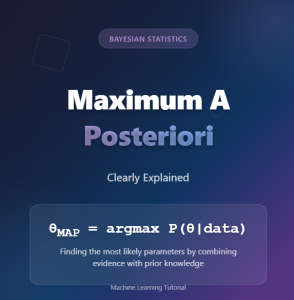
This is one of the most beautiful connections in machine learning – let me break down exactly why Ridge regression is MAP estimation in disguise. Let’s look at the concept step-by-step with a concrete numerical example. This is supporting notes to the MAP explanation where we see Ridge Regression as MAP estimation in the explanation about Maximum A Posteriori (MAP. This will make more sense once you read the linked article.
The Core Connection: Ridge = MAP
The key insight is that when you do Ridge regression, you’re actually solving a Bayesian problem without realizing it!
- The Bayesian Setup:
- You assume your data has Gaussian noise:
y = Xθ + εwhereε ~ N(0, σ²) - You assume coefficients have a Gaussian prior:
θ ~ N(0, σ₀²)
- You assume your data has Gaussian noise:
- The Math:
- MAP wants to maximize:
P(θ|data) ∝ P(data|θ) × P(θ) - This becomes: maximize
exp(-||y-Xθ||²/2σ²) × exp(-||θ||²/2σ₀²) - Taking logs: maximize
-||y-Xθ||²/2σ² - ||θ||²/2σ₀² - Which equals: minimize
||y-Xθ||² + (σ²/σ₀²)||θ||²
- MAP wants to maximize:
- The Connection:
- Let
λ = σ²/σ₀²(the ratio of noise variance to prior variance) - Ridge minimizes:
||y-Xθ||² + λ||θ||² - This is exactly the same thing!
- Let
What This Means Practically:
When you set λ = 1.0 in Ridge regression, you’re saying:
– “I believe the noise variance equals my prior variance on coefficients”
– “I want to balance data fit and coefficient size equally”
When you set λ = 10.0:
– “I believe either: (a) my data is very noisy, OR (b) coefficients should be very small”
– “I want to penalize large coefficients strongly”
When you set λ = 0.1:
– “I believe either: (a) my data has little noise, OR (b) coefficients can be reasonably large”
– “I want to mostly trust the data”
The Formula Breakdown:
In the manual implementation:
python
θ_MAP = (X^T X + λI)^(-1) X^T y
- X^T X: How features correlate with each other
- λI: The regularization term (λ times identity matrix)
- Adding λI: Makes the matrix easier to invert AND shrinks coefficients
Compare to regular regression:
python
θ_MLE = (X^T X)^(-1) X^T y # No λI term
Why λI Shrinks Coefficients?
The identity matrix I adds λ to each diagonal element of X^T X. This has two effects:
- Numerical stability: Makes matrix inversion more stable
- Coefficient shrinkage: The larger
λ, the more coefficients get pulled toward zero
Think of it as: “For every unit of coefficient size, you pay a penalty of λ”
Ridge regression isn’t an arbitrary mathematical trick – it’s the mathematically optimal solution if you believe:
– Your noise is Gaussian
– Your coefficients should probably be small
– You want the single best estimate (not uncertainty)
The Setup: What We’re Trying to Solve
We have a linear regression problem:
– Data: X (features) and y (target values)
– Goal: Find the best coefficients θ (theta) for the model y = Xθ + noise
The question is: what does “best” mean?
Method 1: Maximum Likelihood Estimation (MLE)
MLE says: Find θ that makes our observed data most likely.
python
# MLE solution (regular linear regression)
θ_MLE = (X^T X)^(-1) X^T y
Problem: With small datasets or many features, this can overfit badly.
Method 2: MAP Estimation with Gaussian Priors
MAP says: Find θ that balances what the data tells us with what we believed beforehand.
Step 1: Set Up Our Bayesian Assumptions
python
# Assumption 1: Noise in our data is Gaussian
# y = Xθ + ε, where ε ~ N(0, σ²)
# This means: P(y|X,θ) ~ N(Xθ, σ²I)

# Assumption 2: Coefficients have Gaussian prior
# θ ~ N(0, σ₀²I)
# This means we believe coefficients are probably close to zero
Step 2: Write Down the MAP Objective
Using Bayes’ theorem:
python
P(θ|data) ∝ P(data|θ) × P(θ)
Taking the log (easier to work with):
python
log P(θ|data) = log P(data|θ) + log P(θ) + constant
Step 3: Substitute Our Gaussian Assumptions
python
# Likelihood term: log P(y|X,θ)
likelihood = -1/(2σ²) * ||y - Xθ||²

# Prior term: log P(θ)
prior = -1/(2σ₀²) * ||θ||²

# Total objective to maximize:
objective = -1/(2σ²) * ||y - Xθ||² - 1/(2σ₀²) * ||θ||²
Step 4: Convert to Minimization Problem
Maximizing the above is the same as minimizing its negative:
python
minimize: (1/2σ²) * ||y - Xθ||² + (1/2σ₀²) * ||θ||²
Multiply through by 2σ² to clean up:
python
minimize: ||y - Xθ||² + (σ²/σ₀²) * ||θ||²
Aha! Let λ = σ²/σ₀², and we get:
python
minimize: ||y - Xθ||² + λ * ||θ||²
This is exactly the Ridge regression objective!
The Mathematical Solution
Taking the derivative and setting to zero:
python
d/dθ [||y - Xθ||² + λ||θ||²] = 0
Working this out:
python
-2X^T(y - Xθ) + 2λθ = 0
X^T y - X^T X θ + λθ = 0
(X^T X + λI) θ = X^T y
Therefore:
python
θ_MAP = (X^T X + λI)^(-1) X^T y
This is exactly what Ridge regression computes!
What Each Component Means
Let me break down the formula θ_MAP = (X^T X + λI)^(-1) X^T y:
Without Regularization (λ = 0):
python
θ_MLE = (X^T X)^(-1) X^T y # Regular linear regression
With Regularization (λ > 0):
python
θ_MAP = (X^T X + λI)^(-1) X^T y # Ridge regression
The λI term:
– λ: Controls strength of our prior belief that coefficients should be small
– I: Identity matrix ensures we regularize all coefficients equally
– λI: Adds λ to each diagonal element of X^T X
Intuitive Understanding
What λ Does Geometrically:
- λ = 0: Pure MLE, no regularization
- λ small: Slight preference for smaller coefficients
- λ large: Strong preference for smaller coefficients
- λ → ∞: Forces all coefficients toward zero
The Bayesian Interpretation:
- σ² (noise variance): How noisy our data is
- σ₀² (prior variance): How much we allow coefficients to vary
- λ = σ²/σ₀²: The ratio tells us how much to trust data vs. prior
Practical Demonstration
Let me show you this connection with code:
python
import numpy as np
from sklearn.linear_model import Ridge

# Generate sample data
np.random.seed(42)
X = np.random.randn(50, 5)
y = np.random.randn(50)

# Method 1: sklearn Ridge
ridge_model = Ridge(alpha=1.0)
ridge_model.fit(X, y)
sklearn_coef = ridge_model.coef_

# Method 2: Manual MAP calculation
def manual_map_regression(X, y, lambda_reg=1.0):
    XtX = X.T @ X
    identity = np.eye(X.shape[1])
    map_coef = np.linalg.inv(XtX + lambda_reg * identity) @ X.T @ y
    return map_coef

manual_coef = manual_map_regression(X, y, lambda_reg=1.0)

print(f"Sklearn Ridge:  {sklearn_coef}")
print(f"Manual MAP:     {manual_coef}")
print(f"Difference:     {np.abs(sklearn_coef - manual_coef).max():.10f}")
They should be nearly identical!
Free Course
Master Core Python — Your First Step into AI/ML
Build a strong Python foundation with hands-on exercises designed for aspiring Data Scientists and AI/ML Engineers.
Start Free Course →Trusted by 50,000+ learners

Related Course
Master Statistics — Hands-On
Join 5,000+ students at edu.machinelearningplus.com
Explore Course
Related Articles