How to Fine-Tune LLMs with LoRA in Python — A Complete Guide
Learn how to fine-tune large language models with LoRA in Python using PEFT and TRL — covers LoraConfig, QLoRA, SFTTrainer, model merging, and common...

Learn how LLMs work step by step. Build an inference simulator in Python — tokenize, embed, compute attention, sample, and decode with runnable code...
Build a Python AI chatbot with conversation memory that actually remembers. Raw HTTP tutorial with streaming, 3 hands-on exercises, and complete code you can...
Build your first AI app with Python and the OpenAI API. Step-by-step tutorial covering chat completions, streaming, error handling, and cost control — with...
11 min
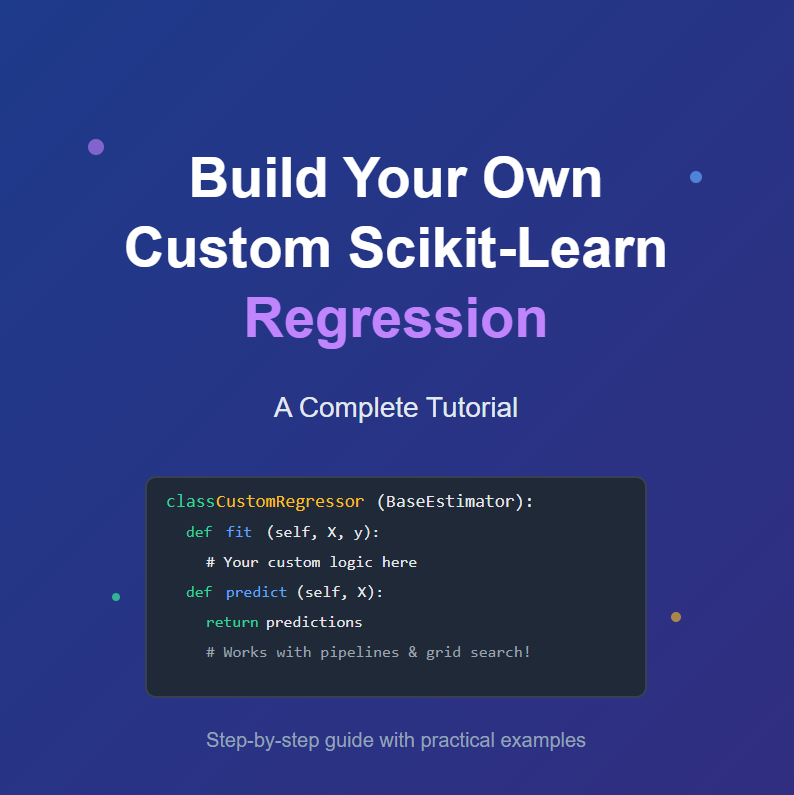
Creating custom regressors in scikit-learn means building your own machine learning models that follow scikit-learn’s API conventions, allowing them to work seamlessly with pipelines,...
If you’ve ever read a scientific study, survey results, or even a political poll, you’ve probably encountered confidence intervals (CIs). They’re one of the...
14 min
Optimal chunk size for RAG systems typically ranges from 128-512 tokens, with smaller chunks (128-256 tokens) excelling at precise fact-based queries while larger chunks...
This is one of the most beautiful connections in machine learning – let me break down exactly why Ridge regression is MAP estimation in...
14 min
Maximum A Posteriori (MAP) estimation is a Bayesian method for finding the most likely parameter values given observed data and prior knowledge. Unlike maximum...
28 min
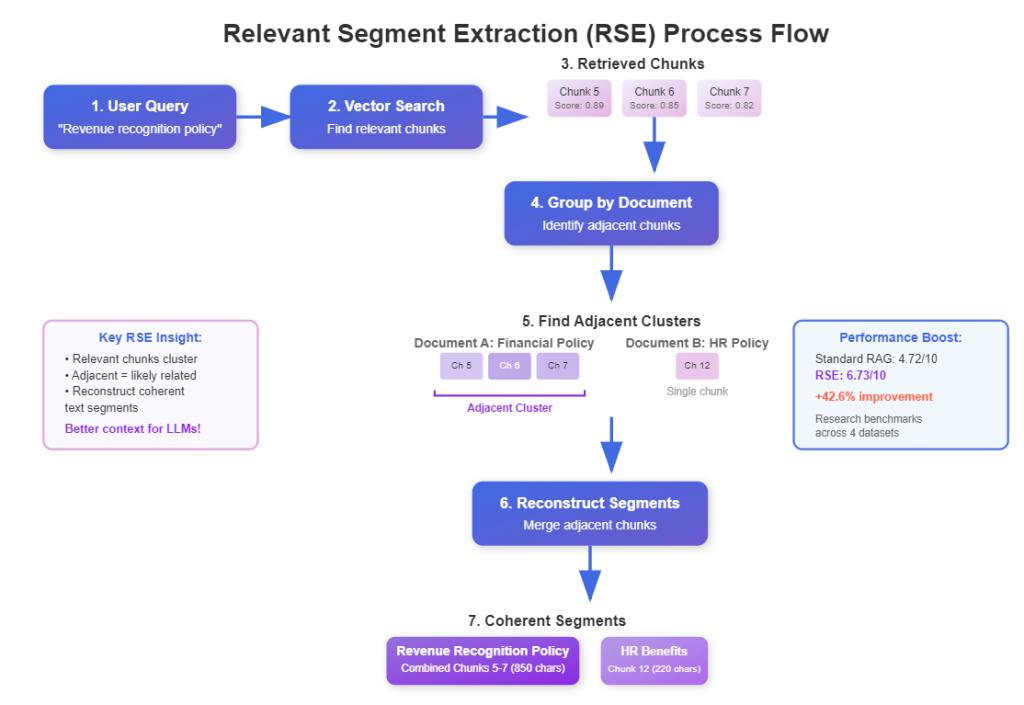
Relevant Segment Extraction (RSE) is a query-time post-processing technique that intelligently combines related text chunks into longer, coherent segments, providing LLMs with better context...
Ollama is a tool used to run the open-weights large language models locally. It’s quick to install, pull the LLM models and start prompting...
While GPUs ((Graphics Processing Unit) are in high demand in video games, with the rise of Large Language Models (LLMs), GPUs are in high...
Cross-entropy is a measure of error, while mutual information measures the shared information between two variable. Both concepts used in information theory, but they...
The F statistic is used in statistical hypothesis testing to determine if there are significant differences between group means. It is most commonly used...
Bayesian Optimization is a method used for optimizing ‘expensive-to-evaluate’ functions, particularly useful in hyperparameter tuning for machine learning models. Let’s understand how it works...
2 min
Joint probability and conditional probability are two concepts in probability theory that deal with the likelihood of events, but they are used in different...
6 min
Using Cython, you can speed up existing Python code by an order of 100x or more. This is possible because Cython converts some of...
Let’s see how to cythonize Python code inside Jupyter notebooks step by step. In this post we will see how to: Define and time...
3 min
At its core, KL (Kullback-Leibler) Divergence is a statistical measure that quantifies the dissimilarity between two probability distributions. Think of it like a mathematical...
The Probe method is a highly intuitive approach to feature selection. If a feature in the dataset contains only random numbers, it is not...
Get the exact 10-course programming foundation that Data Science professionals use.